

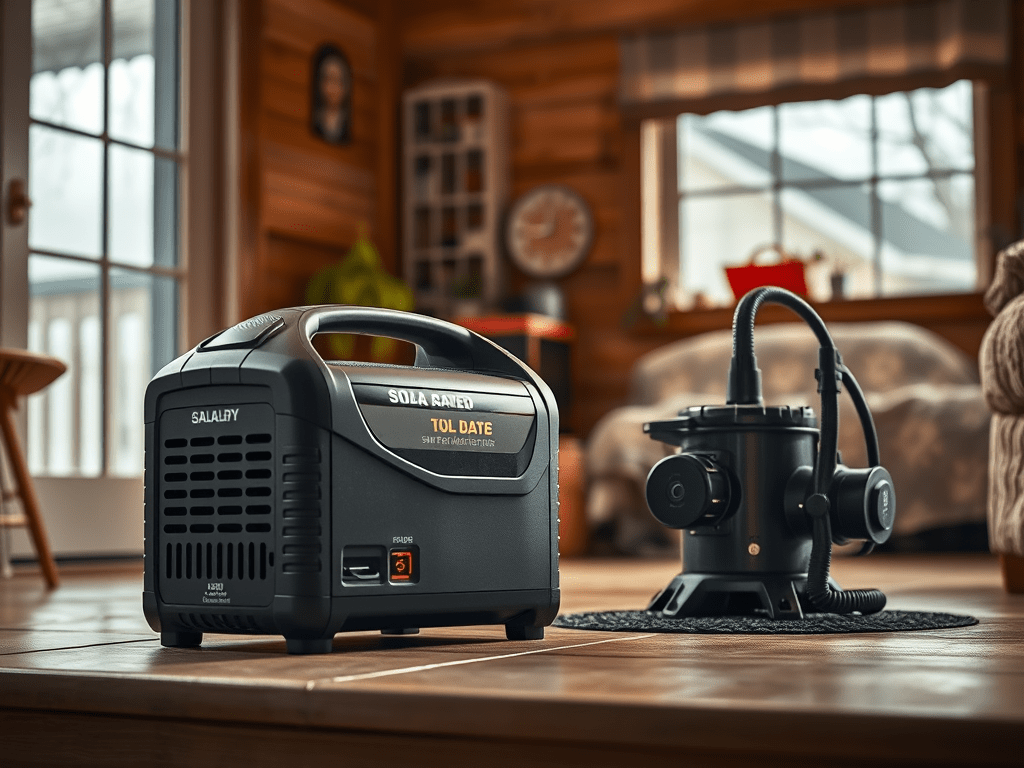
A sump pump that loses power during a storm can leave a basement underwater in minutes. A solar generator is one of the most practical backup solutions: it works indoors without fumes, switches on without manual intervention, and recharges from solar panels or a standard outlet between uses.
This guide covers exactly what to look for, which models handle typical residential pumps, and how to avoid the most common sizing mistake.
The One Spec That Determines Whether It Works: Surge Wattage
Most buyers focus on battery capacity. The more important number for sump pump backup is surge wattage — the peak power the generator can deliver for the two to three seconds it takes a pump motor to start.
Sump pump motors draw two to four times their running wattage at startup. A generator that can’t meet that surge will fail to start the pump even if the battery is fully charged.
| Pump Size | Running Watts | Startup Surge |
|---|---|---|
| 1/3 HP | ~800W | 1,300–2,900W |
| 1/2 HP | ~1,050W | 2,150–4,100W |
Check your pump’s nameplate or manual for its exact HP rating, then choose a generator with a surge rating comfortably above the startup figure — not just above the running wattage.
Top Solar Generators for Sump Pump Backup
| Generator | Battery Capacity | Continuous Power | Surge Power | Best Fit |
|---|---|---|---|---|
| EcoFlow Delta Pro | 3.6 kWh | 3,600W | 7,200W | 1/2 HP pumps; extended outages |
| Pecron E2000LFP | ~2 kWh | 2,000W | 4,000W | Most 1/3–1/2 HP pumps |
| Champion 998Wh | 998Wh | 1,000W | 2,000W | 1/3 HP pumps; shorter outages |


For most homes with a 1/3 to 1/2 HP pump, the Pecron E2000LFP or EcoFlow Delta Pro covers the surge requirement with margin. The Champion is adequate for smaller pumps and shorter outages but leaves little headroom for a 1/2 HP motor at startup.
How Long Will It Last During a Storm?
Sump pumps don’t run continuously — they cycle on when the pit fills and shut off again. During a typical storm, a pump might run for a few minutes out of every hour. That cycling behavior extends battery runtime considerably beyond what a continuous-draw calculation would suggest.
| Battery Capacity | Estimated Runtime (Intermittent Cycling) |
|---|---|
| 1 kWh | 2–4 hours |
| 2 kWh | 5–10 hours |
| 3.6 kWh | 10–20+ hours |
These are estimates — actual runtime depends on how frequently your pump cycles, which varies with groundwater conditions and storm intensity. During a slow-draining storm that runs the pump heavily, assume the lower end of each range.
With solar panels recharging during daylight hours, a system can sustain multi-day outages in most scenarios.
Solar Generator vs. Gas Generator for Sump Pump Use
| Factor | Solar Generator | Gas Generator |
|---|---|---|
| Indoor use | Safe — no emissions | Never safe indoors |
| Startup | Automatic | Manual or transfer switch |
| Fuel required | None | Must be stocked and fresh |
| Noise | Silent | Loud |
| Maintenance | None | Annual servicing required |
| Upfront cost | $750–$1,600 | $500–$2,000 |
The practical case for solar over gas in this specific application is strong: sump pump outages happen during storms, often at night, when running outside to start a generator — or storing and rotating fuel — is a real friction point. A solar generator sits plugged in, charged, and ready without any action required.
Common Questions — Answered Directly
Will it actually start my pump? Only if the surge rating exceeds your pump’s startup draw. This is where buyers most commonly go wrong — purchasing based on battery capacity or continuous wattage without checking surge. Confirm your pump’s startup wattage before buying any generator.
Can solar panels keep it running through a multi-day storm? In most cases, yes. A 200–400W panel array recharges the battery during daylight gaps even in overcast conditions. If your pump cycles intermittently, daytime recharging can fully offset overnight discharge through a two to three day storm event.
What if my pump runs constantly during heavy flooding? That scenario — a pump running near-continuously for hours — requires a larger battery than most portable solar generators provide. For properties with serious flooding risk or high water tables, consider a dedicated battery backup sump pump system as a complement, or size up to a 3.6+ kWh generator with a solar panel array.
Example Setup: Storm-Ready Sump Backup
| Component | Specification |
|---|---|
| Solar generator | 2,000–3,600W inverter, 2–3.6 kWh battery |
| Solar panels | 200–400W |
| Total estimated cost | $1,200–$2,500 |
Keep the generator plugged into a wall outlet when not in use so it stays charged. Connect it directly to the sump pump with an appropriate extension cord rated for the pump’s amperage. No transfer switch or electrician is required for this configuration.
Before You Buy: Key Checks
- Find your pump’s horsepower rating — it’s on the motor nameplate or in the documentation
- Look up its startup surge wattage; if unavailable, use 3× the running wattage as an estimate
- Choose a generator with a surge rating at least 20% above that number
- Confirm the battery capacity covers your expected outage duration at your pump’s cycling frequency
- Verify solar panel input compatibility if you plan to add panels for recharging
